Setting Up a Business Bank Account: The Complete Guide for UK Ecommerce Sellers
Most ecommerce sellers who mix personal and business money lose, on average, several hours of accountant time untangling transactions at year-end, and pay for the privilege. Setting up a business bank account is one of the most practical steps you can take before your first sale clears.
This guide walks through everything UK ecommerce sellers need to know: what documents you need, which account type suits your structure, what fees to expect, and the mistakes that catch out first-timers.
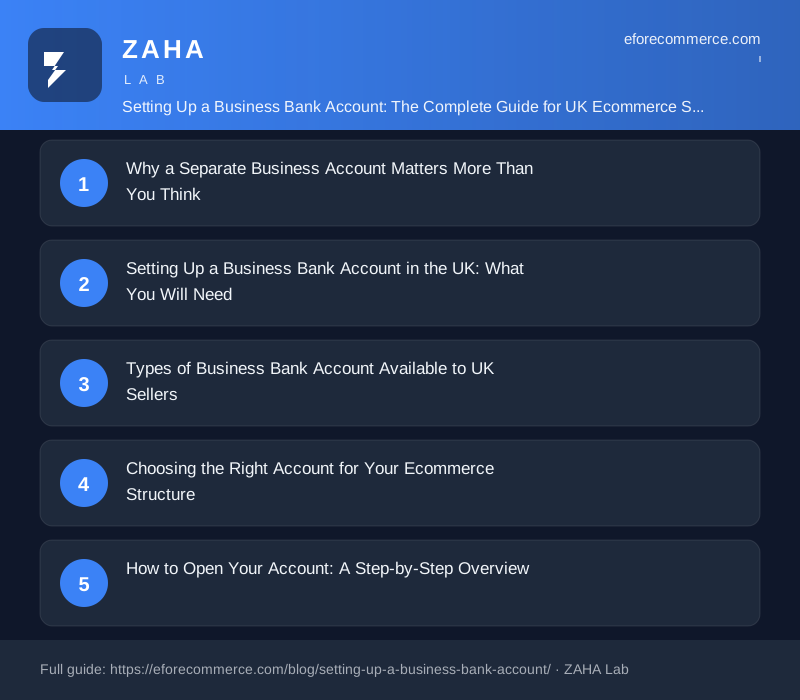
Why a Separate Business Account Matters More Than You Think
When you sell on marketplaces or through your own store, money moves fast, platform payouts, supplier payments, VAT transfers, refunds, ad spend. If all of that flows through a personal current account, you cannot get a clean picture of your actual trading position without manual sorting.
The consequences are practical rather than merely administrative. HMRC expects clear records, and "I paid for stock using my personal card" is not a clean audit trail. If you are registered as a limited company, mixing funds can also blur the legal separation between you and the business, potentially exposing personal assets if things go wrong.
There is also a less obvious benefit: payment processors and wholesale suppliers often treat a business account as a signal of legitimacy. Some drop shippers and distributors will not open a trade account for a seller who cannot provide business banking details.
Setting Up a Business Bank Account in the UK: What You Will Need
Before you apply, whether online or in a branch, gather the documents that almost every provider will request. The exact list varies by account type and provider category, but in most cases you will need:
- Proof of identity, a valid passport or driving licence for each director or sole trader
- Proof of address, a utility bill or bank statement dated within the last three months
- Business registration details, your Companies House registration number if you are a limited company, or your UTR (Unique Taxpayer Reference) if you are a sole trader
- Business address, this can be your home address for most small ecommerce operations
- Estimated annual turnover, a rough figure is normally sufficient at the application stage
- Nature of business description, a brief explanation of what you sell and how
For limited companies, you will also typically need to provide your memorandum and articles of association, though many digital providers pull this directly from the Companies House register once you supply your company number.
Sole traders face a lighter documentation burden, but it is worth noting that some traditional high-street banks require a minimum trading history or a minimum projected turnover before they will approve an account. Digital-first providers generally have fewer of these restrictions.
Types of Business Bank Account Available to UK Sellers
Not all business accounts are the same, and the differences matter more than the name on the card.
Traditional high-street business current accounts offer the full suite of services, branch access, cheque books, cash handling, and in-branch support. Monthly fees typically range from around £5 to £15 for basic accounts, with transaction fees layered on top. For a purely digital ecommerce operation, the branch network is rarely useful, which makes these fees hard to justify in the early stages.
Digital business accounts and e-money accounts have grown substantially in the UK market. These providers operate primarily through apps and web dashboards, approval can take minutes rather than weeks, and many offer free or very low-cost tiers. The trade-off is that some are e-money institutions rather than fully authorised banks, which means deposits may not be covered by the Financial Services Compensation Scheme (FSCS) in the same way. Always check the regulatory status before depositing significant sums.
Business savings accounts and reserve accounts are worth considering once your trading account is established. Holding a VAT pot or a stock reserve in a separate account that earns interest, even at a modest rate, is better than letting it sit idle. Many ecommerce sellers treat VAT as untouchable the moment it comes in; a separate sub-account or pot makes that discipline automatic.
Choosing the Right Account for Your Ecommerce Structure
The right account depends on your legal structure and your transaction volume.
If you are a sole trader turning over under around £30,000 a year with straightforward income from one or two platforms, a free or low-cost digital account is almost always sufficient. The main requirements are clean transaction records, easy bank-feed integration with accounting software, and the ability to pay suppliers by faster payment or BACS.
If you are a limited company, you are legally required to keep company finances separate from personal funds. A dedicated company bank account is not technically mandated by law, but it is effectively unavoidable for good governance, and most accountants will refuse to prepare accounts from commingled records without charging significantly more for the sorting work.
If your business sells in multiple currencies, buying stock from overseas suppliers or selling to international customers, look for an account that holds foreign currency balances or offers competitive exchange rates. Converting every supplier invoice at a retail FX rate adds up quickly; on a £100,000 annual stock budget, the difference between a specialist rate and a high-street rate could easily run to several hundred pounds.
For sellers with high transaction volumes, processing thousands of orders a month, check whether the account charges per-transaction fees. A fee structure that looks cheap at 50 transactions a month becomes expensive at 5,000.
How to Open Your Account: A Step-by-Step Overview
The process varies by provider, but the broad sequence is consistent.
Step 1, Choose your provider type. Decide between a traditional bank and a digital provider based on your needs above. If you need cash handling, a high-street option is necessary. If you operate entirely online, a digital provider is likely faster and cheaper to set up.
Step 2, Complete the application. Digital providers typically offer a fully online application taking between 10 and 30 minutes. Traditional banks may require an in-branch appointment or a longer online process with document uploads. Limited company applications go through additional checks against Companies House data.
Step 3, Pass identity and business verification. This is where delays happen. Ensure documents are in date and that the name on all documents matches exactly. Discrepancies, a middle name on a passport but not on a utility bill, for example, are a common cause of rejection or delays.
Step 4, Account activation and setup. Once approved, set up your accounting software bank feed immediately. Most major accounting platforms support direct connections to business accounts via Open Banking. Connecting this on day one saves hours of manual reconciliation later.
Step 5, Notify payment processors and platforms. Update your payout details on any marketplace or payment processor as soon as the account is live. Keep your old account active long enough to receive any pending payouts that are already in transit.
Fees and Costs: What to Budget For
Business banking costs are easy to underestimate. Here is what to check before you commit:
- Monthly account fee, ranges from £0 (free-tier digital accounts) to around £25 for premium traditional accounts
- Transaction fees, some providers charge 20–30p per outgoing faster payment above a monthly allowance
- Cash deposit fees, typically 0.5–1% for high-street cash deposits; most digital accounts charge more or do not accept cash at all
- International transfer fees, flat fees of £5–£25 per transfer are common at traditional banks; specialist FX-friendly accounts often charge less
- Introductory periods, some traditional banks offer 12–24 months fee-free for new businesses; useful, but model what you will pay once the period ends
For most early-stage ecommerce sellers, the total annual cost of a sensibly chosen business account should be well under £200. If you are being quoted significantly more, it is worth comparing alternatives.
Common Mistakes Ecommerce Sellers Make With Business Banking
These errors are common enough to be worth naming explicitly.
Delaying the account until after launch. Opening an account after you have already started trading creates a retroactive sorting problem. Set up the account before you take your first order.
Choosing based only on the free period. An 18-month fee-free offer sounds attractive, but if the standard tariff is expensive and switching costs are high (notifying payment processors, updating direct debits, reconnecting accounting software), you may end up paying more in the medium term.
Using an e-money account for large balances without understanding FSCS coverage. The FSCS protects deposits up to £85,000 per person per authorised institution. Some digital business accounts are e-money institutions, not banks, and protection works differently. Read the regulatory status before depositing significant reserves.
Not setting up a VAT sub-account or pot. Spending VAT you have collected is one of the most common cash flow mistakes in ecommerce. A dedicated pot, even within the same account, creates a visual and psychological barrier that helps.
Ignoring multi-currency needs until it is too late. If you are sourcing from international suppliers now, solve the currency question at the banking stage, not after you have committed to a single-currency account.
Frequently Asked Questions
Do I legally need a business bank account as a sole trader in the UK?
There is no legal requirement for sole traders to hold a separate business account in the UK. Unlike a limited company, where the business is a separate legal entity, a sole trader and their business are legally the same person. That said, keeping finances separate is strongly recommended for practical tax record-keeping, and HMRC expects clear, auditable records. Most accountants advise opening a dedicated account regardless of legal structure.
How long does it take to open a business bank account in the UK?
Digital-first providers can approve and activate an account in as little as a few hours to one or two business days for straightforward sole trader applications. Limited company applications typically take longer, sometimes three to five business days, due to additional verification checks. Traditional high-street banks can take several weeks, particularly if in-branch appointments are required. Having your documents ready in advance is the single biggest factor in avoiding delays.
Can I use a personal bank account for my ecommerce business?
Technically, sole traders are permitted to use a personal account for business transactions, but most personal account terms and conditions prohibit using the account for business purposes, check your specific terms, as a breach can result in the account being closed. Beyond the contractual risk, the practical downsides are significant: no clean separation for tax, no business credibility with suppliers, and no bank-feed categorisation for accounting software. For limited companies, using a personal account is not appropriate under any circumstances.
Disclosure: this post contains affiliate links. If you join through one of them we earn a commission, at no extra cost to you. It does not change what we recommend.
Building the money skills behind the store
The operational side of ecommerce, sourcing, pricing, fulfilment, is only half of it. The other half is the financial literacy to read your own numbers, understand cashflow, and make decisions about credit, tax and reinvestment without guessing. That is the part most sellers develop last, and it is the part that decides whether a growing store becomes a durable business.
We use Money.School for this. It is a membership built around practical money education, cashflow modelling, credit and borrowing, margins, tax and reinvestment — taught by people who have actually scaled businesses rather than only theorised about it. It suits sellers who want a structured, ongoing education rather than a one-off course.
- Standard Monthly, £15 + VAT a month
- Standard Yearly, £150 + VAT a year
- Standard Lifetime, £300 + VAT one-off
- GOLD Monthly, £38.33 + VAT a month
- GOLD Yearly, £380 + VAT a year
- GOLD Lifetime, £760 + VAT one-off
The monthly tiers are the low-commitment way in; the lifetime options suit anyone who wants permanent access. If you are weighing it up, start with a monthly plan and judge it against your own numbers.